
By the time a customer complains, you have already lost them.
The warning was on a call weeks earlier. Same issue, third time, and the customer had stopped expecting it to be fixed. Saaransh reads every support call your team takes and tells you which customers are in trouble — while they are still yours.
by Enjay — the team behind Sangam CRM (since 1999)
The support blind spot
You check one call in a hundred. The other ninety-nine decide whether customers stay.
Quality is checked by hand, days later, on a sample too small to mean anything. Saaransh reads all of them, the same day.
Checked by a person, days after the call, chosen at random.
Every call read on the same day, with the moments that matter flagged for you.
The relief
Unhappy customers rarely say they are unhappy.
They stay polite. They stop asking. Then the renewal does not come. Saaransh watches how a customer sounds across all their calls, not just the last one.
- 1
Third call, same issue
A customer calling about the same thing again is the clearest warning you get. Saaransh counts it.
- 2
The mood changed
Patient on the first call, short on the second, silent on the third. You see the direction, not one snapshot.
- 3
Promises that were not kept
“I'll get it fixed by Friday”, said on a call, never written into the ticket, never done.
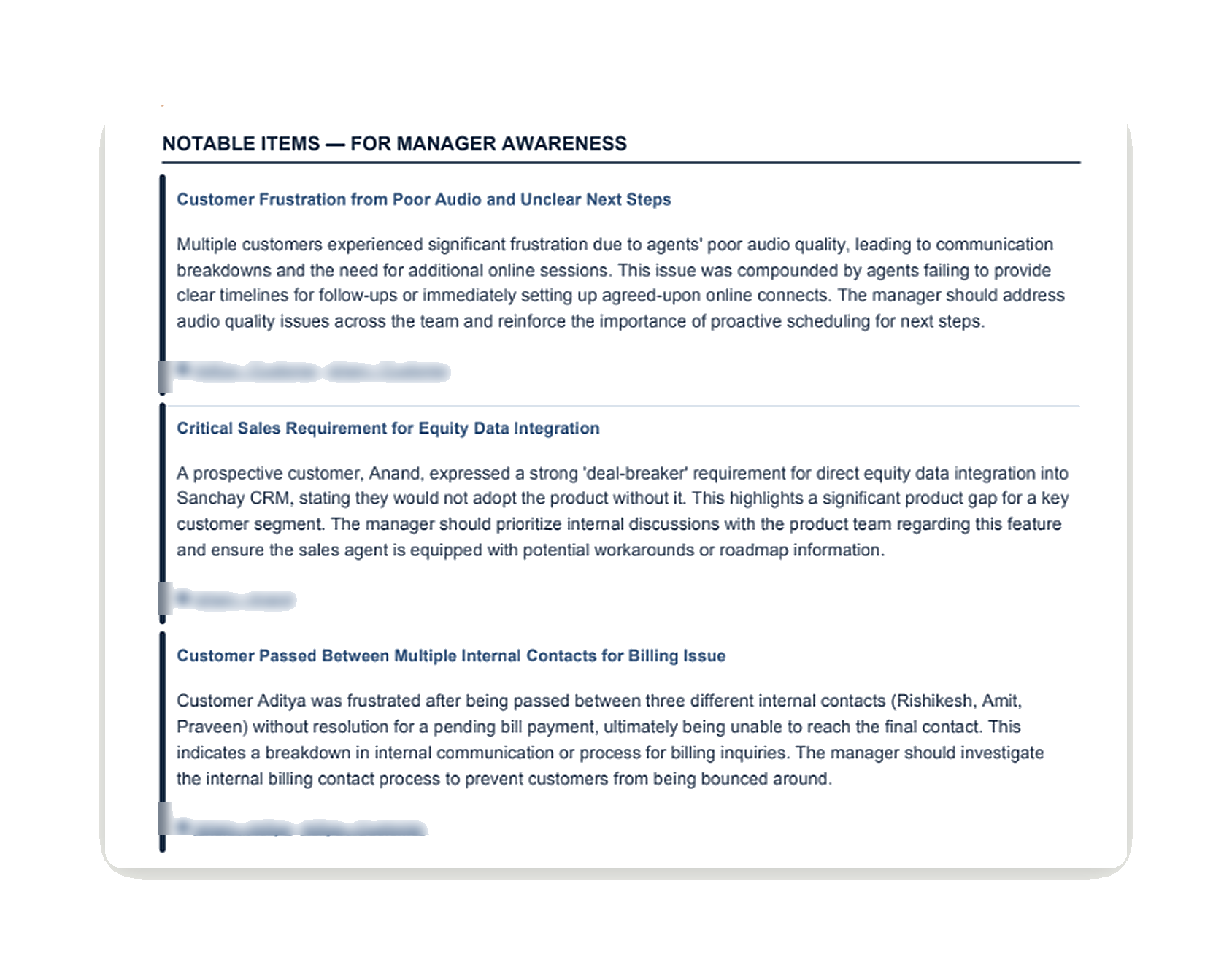
It reaches you every morning, before your first meeting.
A short list of which customers went the wrong way yesterday, and which agent to speak to about it.
- Only the customers that need a decision from you
- Every point links back to the call it came from
- No scores, no rankings, no leaderboards
Where the load comes from
Fifty calls about one thing is a product problem, not a support problem.
Your ticket categories tell you what the agent picked from a dropdown. Saaransh tells you what the customer actually said.
What keeps coming back
Grouped by what was really said on the call, across every customer, every month.
How much of your load it is
So you can say “this one issue is eleven per cent of our calls” and be believed.
Which ones take three calls to close
The problems your team cannot fix the first time, and why.
That is the evidence you take to product or engineering. Not an argument based on how the week felt.
Every ticket, in full
Stop asking the customer to explain it again.
A customer who has explained the same problem to three different agents has already decided how they feel about your support.
- Every previous call with that customer, summarised on the ticket
- What was already tried, so nobody suggests it twice
- What was promised, and by whom
- Whoever picks up next knows the full story in thirty seconds
Written automatically after each call. Nobody has to fill in a wrap-up form for this to work.
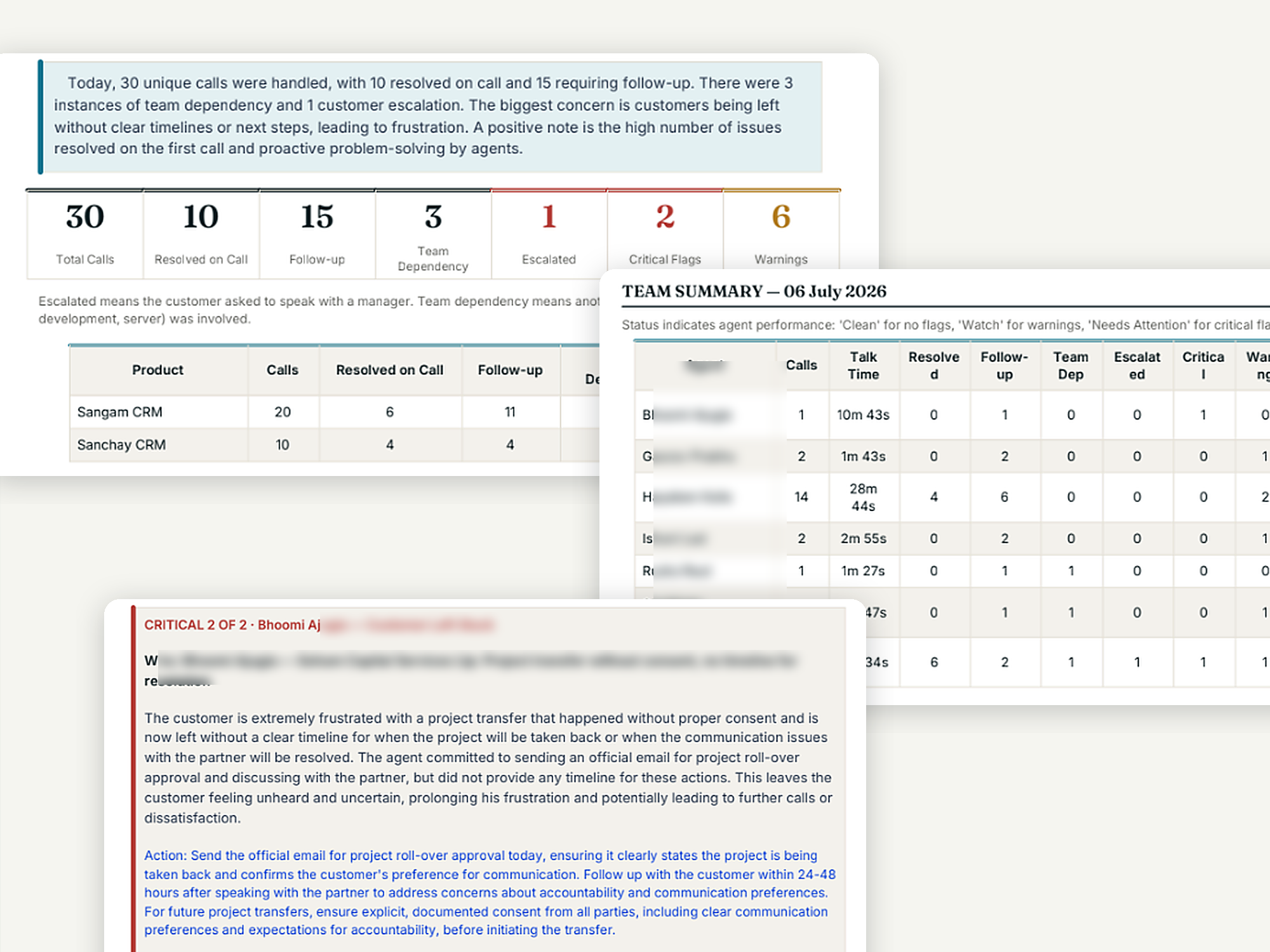
What the support head gets
Four things you could never check before.
Not how fast the call was closed. Whether the customer was actually helped. Saaransh reports on all four for every person, so coaching starts from evidence instead of an impression.
Did they understand the problem?
Or did the agent start answering before the customer had finished explaining?
Was the answer correct?
The right guidance for that customer's setup, not a guess to end the call quickly.
How did the customer sound?
Satisfied, unsure or annoyed — and at which point in the call it changed.
Was it actually resolved?
Or was it closed on paper and the customer called back about the same thing next week?
And month by month you see whether the team is getting better, and whether your own coaching is working — the good calls and the bad ones become the training material your next joiner learns from.
Every call comes back as one of four
A serious mistake, or a call heading towards an escalation. You see it the same day.
Not wrong, but heading the wrong way. Worth a word before it becomes a habit.
Done properly. Problem understood, correct answer, customer left satisfied.
A normal call. Somebody asked, somebody answered. Most calls are these.
You only ever look at the first two. On a hundred calls that is usually five — and those five are the customers you can still keep.
Will my team use it?
Your team will not fight this one.
Support people are watched more than anyone else in the business. This is the first tool that gives them something back.
- 01
The wrap-up form goes away
Every call is written into the ticket without anyone entering it. The queue keeps moving.
- 02
The update is already written
The message back to the customer is drafted. They read it, change what they want, and send.
- 03
Backup when a customer disputes it
What was actually said is on record. Your agent is not left defending their memory.
And this is what it adds up to
The clerical work goes
No wrap-up form, no ticket notes, no update to draft.
The queue moves faster
Minutes back on every call, returned to the agent.
Customers get real answers
That time goes into solving the problem instead of typing.
Fewer customers leave
Problems fixed properly the first time, with nothing forgotten.
The reports
Four reports that change how you run the week.
Instant Serious-Mistake Alert
Catches a call going the wrong way before the customer escalates it for you.
Daily Critical Flags
The customers you can still put right today, while it is still fixable.
Individual Member Report
A precise, personal plan — coaching time goes exactly where it is needed.
Recurring Issue Analysis
What keeps coming back, and how much of your call load it takes up.
Email and WhatsApp. Not a dashboard you have to remember to open.
At a time you set — 9am before your first meeting, or 6pm at the end of the day.
A proper PDF you can read on the phone, forward, or take into a review meeting.
You choose who gets which report. The team head, the team leader, or the person themselves.
Why trust us
Built by Enjay. Proven on our own support desk.
Saaransh comes from the same team as Sangam CRM and Synapse telephony, supporting 5,000+ customers across India since 1999. We have been running our own support desk on it every day for months, which is how the rough edges got found before you had to find them.
First, see whether this is beneficial to you or not.
Saaransh Analyzer learns your business in 15 minutes, then runs on your own support calls while you watch — before you pay anything.
Questions
Support leaders ask us this
The things people actually ask before they buy. If yours is not here, ask us on the demo call.